Changelog

New features in AerScheduler, newest first. The same updates appear in the console and the app as a What's new card for the people they are for.

  1. Inspections that keep themselves current
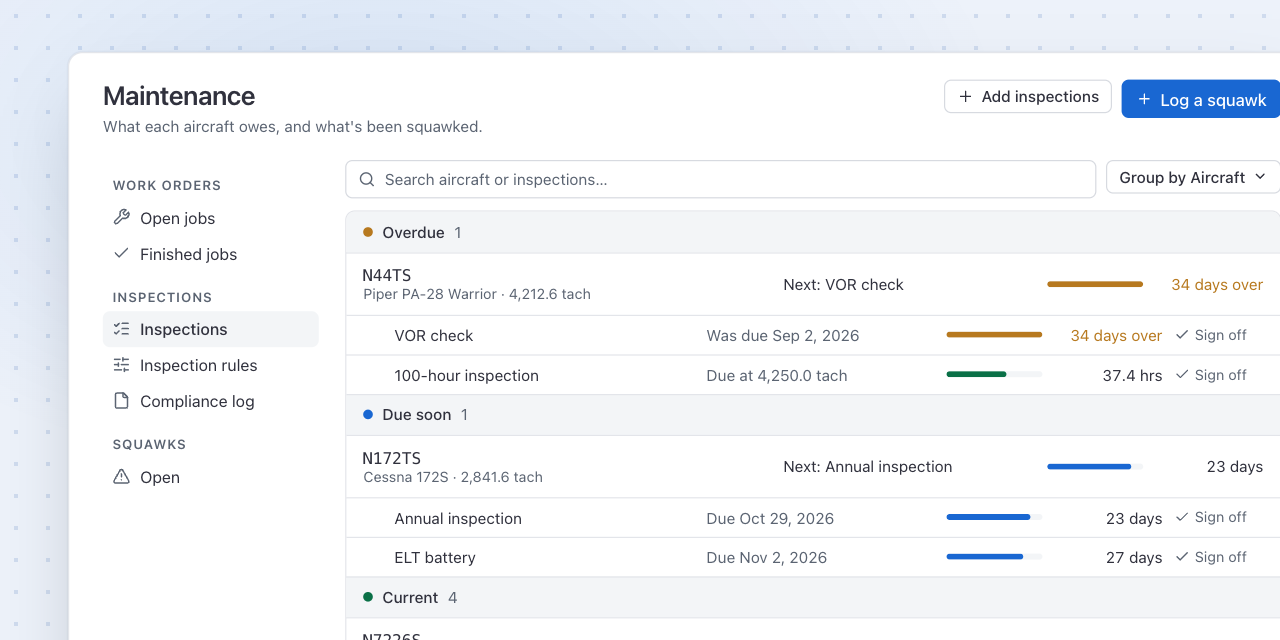
    The Maintenance page with inspections grouped by aircraft, showing what is overdue and due next

    Maintenance now shows every aircraft with the inspection it needs next, how long is left in days or tach hours, and which ones are already overdue. Group the list by aircraft, by status or by inspection, depending on the question you are asking.

    Start with the standard set

    Add the seven AVIATES items in one go, fill in when each was last done, and pick the tails. Add your own inspections and Airworthiness Directives alongside them, counted in calendar months or in tach hours.

    • Reminders in steps

      Warn the shop at 90, 30 and 7 days, or at 25, 10 and 5 hours, and owners of customer aircraft on their own steps.

    • Grounded when it comes due

      An inspection marked Grounds the aircraft grounds its tail when it comes due, and signing it off puts it back on the line.

    • Signed off in one place

      Sign off a completed inspection and the next due date is worked out for you, from the date or the meter.

    • A compliance log

      Every sign-off is kept, with who signed and when, for the next annual or ramp check.

    Not every inspection fits every aircraft

    Mark an inspection not applicable to one tail, with a reason, instead of deleting it for everyone. Change which aircraft an inspection covers, or stop tracking it, from Inspection rules.

    Set it up

    1. Open Maintenance and click Add inspections.
    2. Leave the mode on Standard set and fill in when each was last done.
    3. Pick the tails and click Add.
    Read the guide
  2. A page of their own for aircraft owners

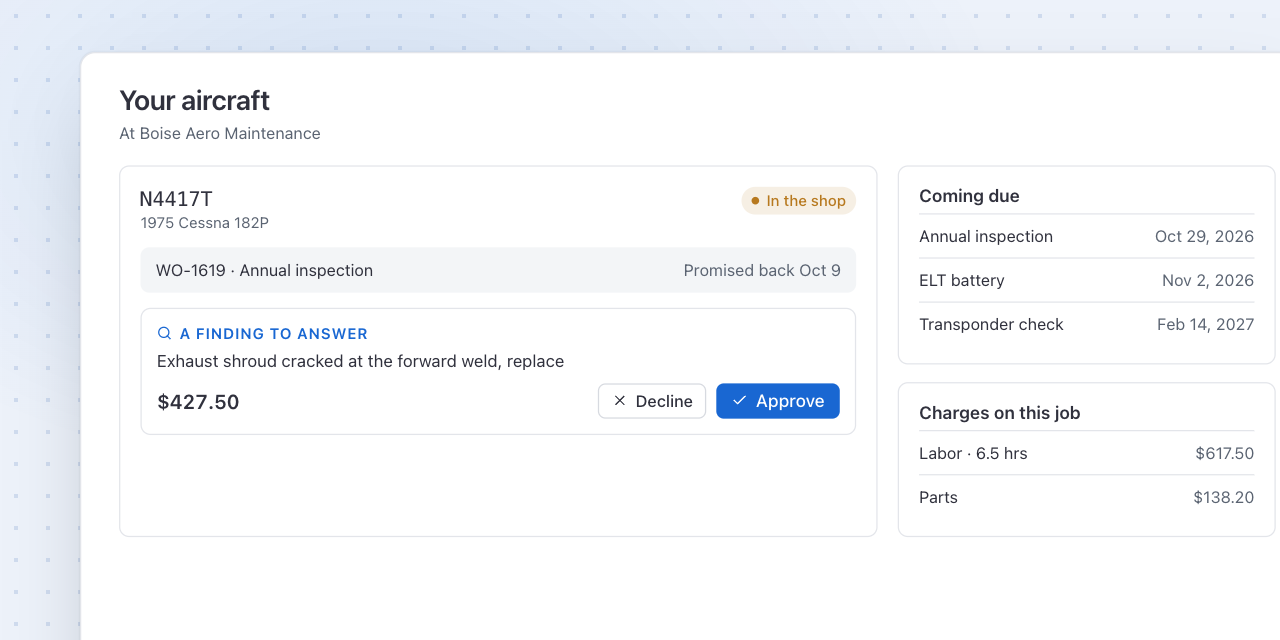
    An aircraft owner's Home page with their aircraft, the job it is in and a finding to answer

    The people who own the aircraft in your hangar now have a page of their own. They sign in with the email address the shop has for them, and see their aircraft, the job each one is in, and what is coming due. No more phone tag to find out whether the annual is done.

    Answer findings without a phone call

    When the shop finds something the owner did not ask for, the owner sees it with the price and approves or declines it, on the web or from the app. The answer lands on the job straight away, along with who gave it and when.

    Ask for work

    An owner can ask for work on their aircraft from their own page: what they need, when it can come in, where it is, and the latest Hobbs and tach. The request opens a job at Requested, ready for the shop to schedule.

    • See the charges on a job as it goes, and pay the invoice online
    • Get emailed when the job moves to a new stage
    • See inspections coming due on each aircraft
    • Shops choose exactly what owners are sent
    Read the guide
  3. Work orders for your maintenance shop

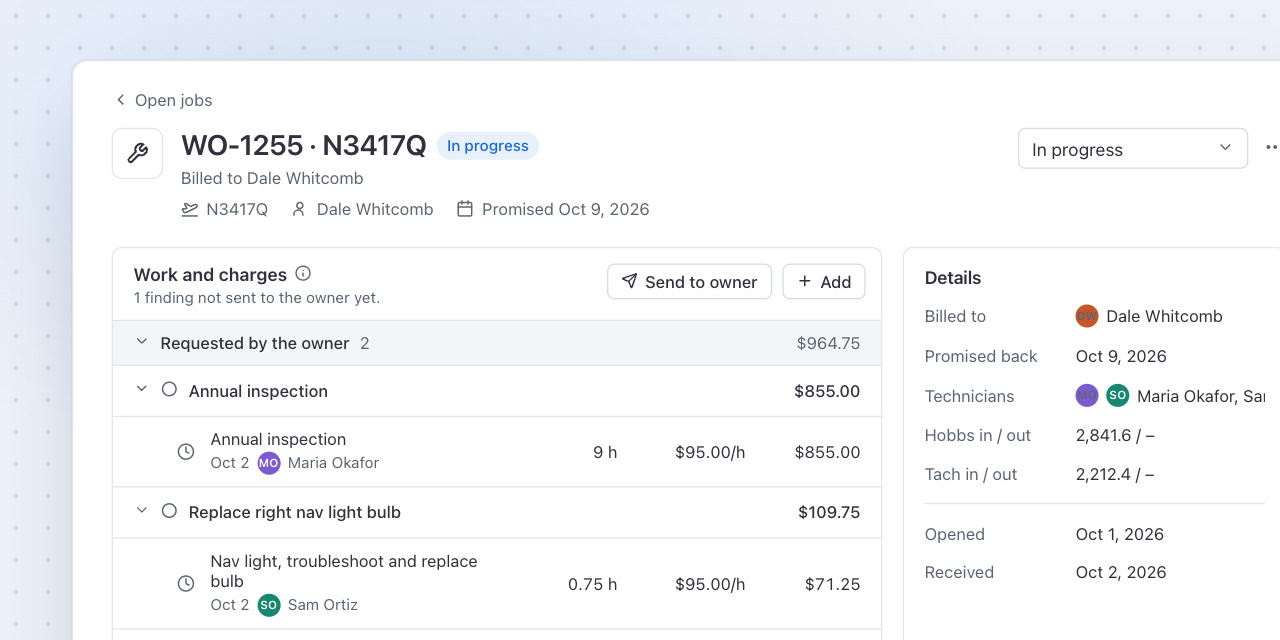
    Work order WO-1255 for N3417Q with labor and parts lines

    Every job on an aircraft now has its own page: who pays, what the owner asked for, where it stands, and everything that went into it. When the aircraft goes home, the invoice comes from the job, so nothing done in the hangar is left off the bill.

    From the first call to the invoice

    Open a job when an owner calls or taxis up. It gets the next number, WO-1001 and up, and moves from Requested and Scheduled through Aircraft received until it goes home. Record the Hobbs and tach when it arrives, assign technicians, and promise a day back. Owners of customer aircraft are emailed as the job moves.

    • Labor and parts as you go

      Technicians log their hours and the parts they fit, each line kept with who added it and when.

    • Findings sent to the owner

      Something the owner did not ask for? Add it as a finding, price it, and send it. They approve or decline from their phone.

    • Invoice from the job

      Raise the invoice when the work is done. Shop rates and parts markup are filled in for you.

    • Only the right people

      Owners, admins and technicians see work orders. Dispatchers and pilots do not, because a job carries the owner's details and prices.

    Open your first job

    1. Go to Maintenance, then Open jobs.
    2. Click Open a work order and pick the aircraft.
    3. Check who pays, write down what the owner asked for, and click Open work order.

    Try your first job on one of your own aircraft, which has no owner to email.

    Read the guide
  4. Sales tax on invoices

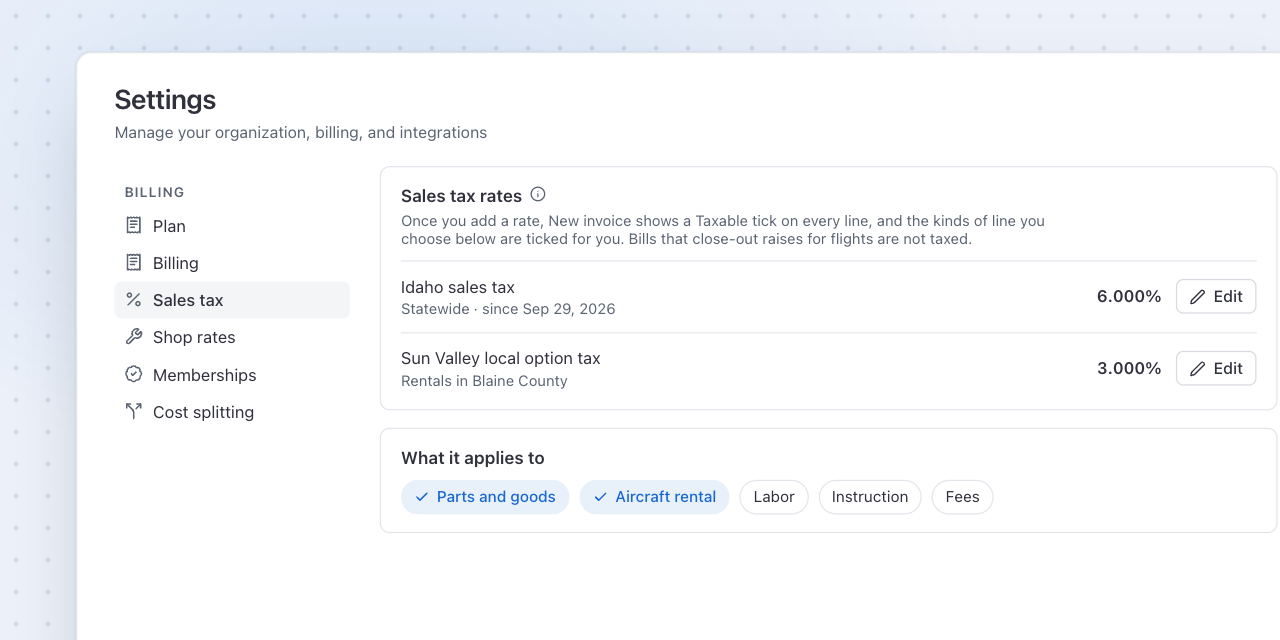
    Sales tax settings with a 6 percent rate applied to parts, goods and rentals

    If your state taxes parts, goods or rentals, you no longer need to work the tax out by hand. Add your rate once, choose which kinds of line it applies to, and every invoice raised with New invoice taxes each line by that rule.

    • Tax parts and goods but not labor, or whatever your state requires
    • Every line still has a Taxable tick you can change
    • Mark a customer exempt, like a dealer buying for resale, and their invoices are never taxed
    • The Tax collected report shows what you owe

    Flight bills from close-out are not taxed. If you use QuickBooks, taxed invoices wait under Needs attention for you to enter there.

    Read the guide
  5. First dibs on cancelled slots

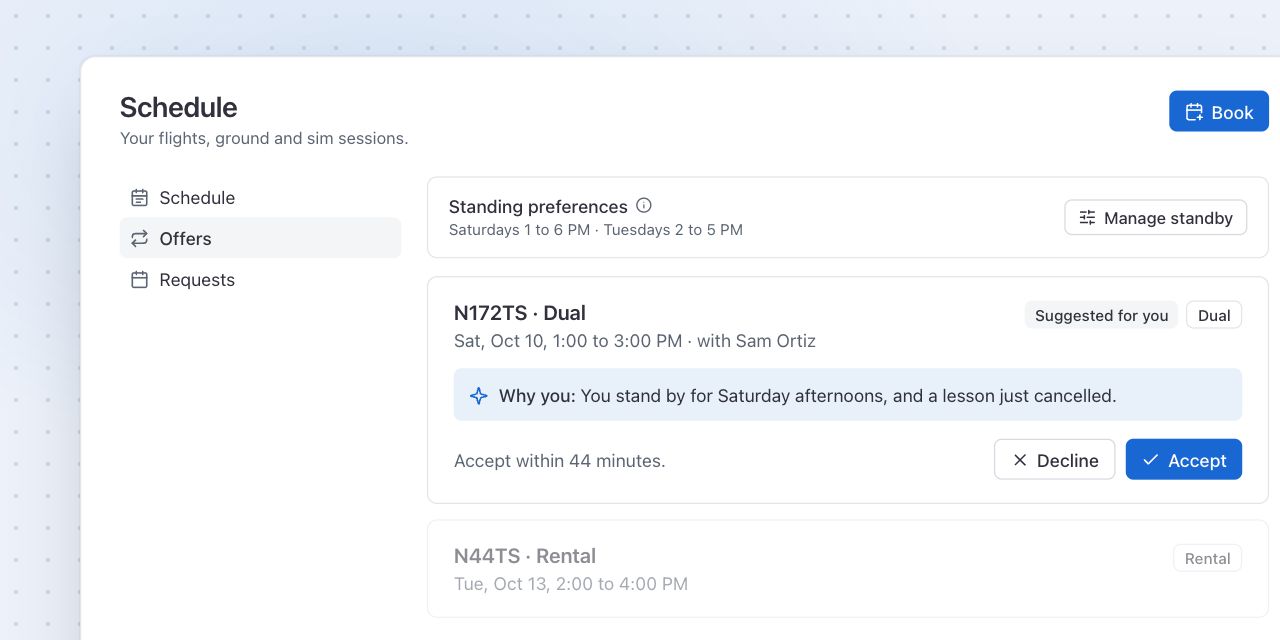
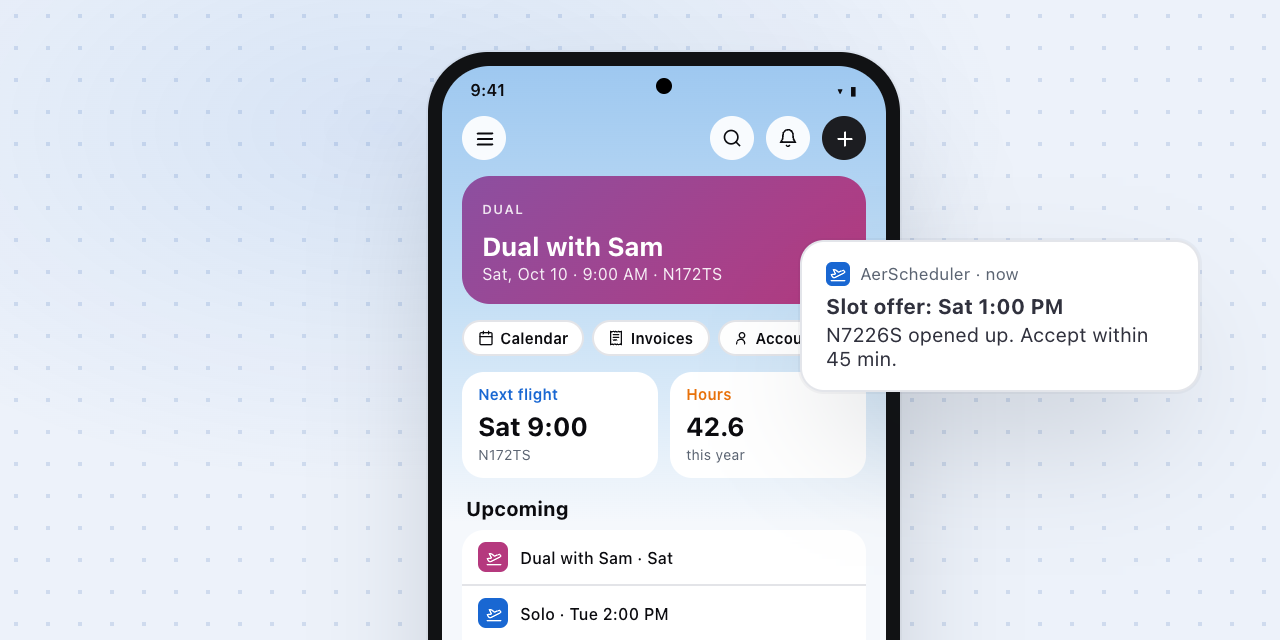
    A slot offer for a Saturday dual lesson in N172TS, with Accept and Decline

    When someone cancels, the open slot no longer goes to waste. Members standing by for that time get a time-limited offer, and accepting it books the flight.

    • Stand by for one booking, or set standing preferences for the days and times you usually fly
    • Accept or decline right from the notification on iPhone
    • Nothing is booked until you accept; a declined offer moves to the next person

    Suggested for you

    When nobody is standing by, a cancelled slot can be suggested to the member whose flying fits it best, with a line saying why. Not interested? One tap stops the suggestions.

    Stand by

    1. Open Schedule, then Offers, and choose Manage standby.
    2. Add the days and times you usually fly.
    3. Or open any booking you want and press Stand by for this booking.

    It is on for everyone. Owners and admins can turn it off under Settings, then Booking preferences.

    Read the guide
  6. The schedule updates live

    When the desk moves a booking, a student cancels from their phone or an invoice is paid, everyone looking at it sees the change straight away. The calendar, the notification bell and billing stay current on their own in the console, and so does the calendar in the app.

  7. Membership plans and dues

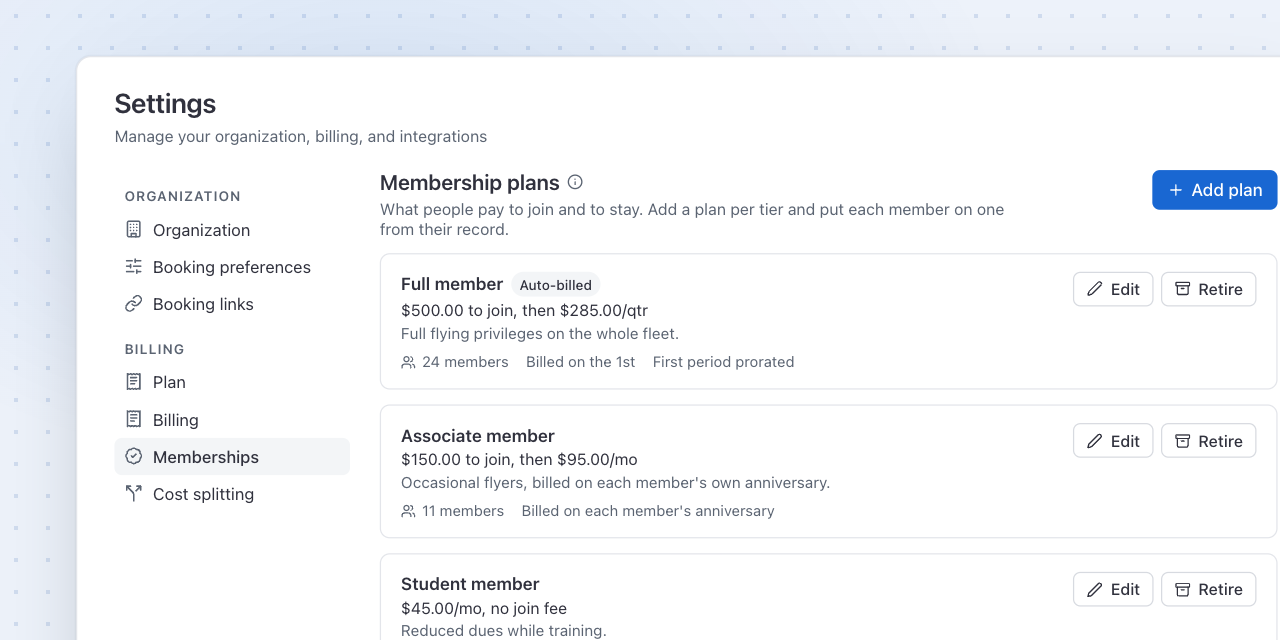
    Membership plans: full, associate and student, with join fees and dues

    Clubs and FBOs can now run membership in the same place as flying. Full, associate and student rate are three plans, each with its own join fee, dues and billing day.

    • A plan for each tier

      A name, an optional join fee, optional recurring dues, and what the tier gets.

    • Billed on your schedule

      Bill dues on the 1st or on each member's own anniversary, with the first period prorated.

    • Ordinary invoices

      Dues show up on Billing and pay through the same link as a flight. Auto-billed plans raise them for you.

    Put each member on a plan

    Open the person's record, go to Billing, and add them to a plan. Their join fee and each period's dues appear there as they come due, and the Memberships and dues report shows what has been billed and collected.

    Read the guide
  8. Prepaid accounts with a running balance

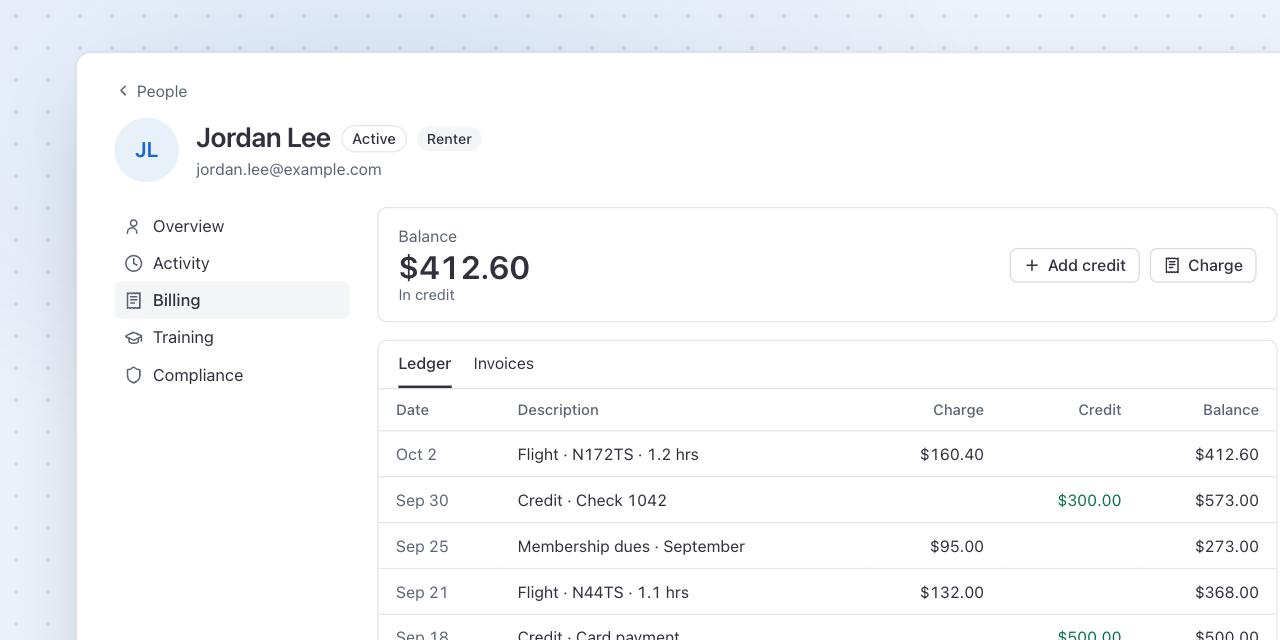
    A member's account ledger with credits, flight charges and a running balance

    Many clubs and schools run on prepaid accounts: a member puts money on account, and each flight comes off it. Switch your organization to Account ledger and that is how AerScheduler bills.

    • Closing out a member's flight posts a charge to their balance instead of raising an invoice
    • Record credits and payments on the member's Ledger
    • Members see their own balance and every charge against it
    • Guests still get a pay-this-visit invoice

    Choose per organization

    Under Settings, then Billing, How members pay offers Invoice each booking, which stays the default, or Account ledger. Only the organization owner can change it, because it changes how everyone is billed.

    Read the guide
  9. Approve bookings before they are made

    Some organizations want a person to look at a booking before it lands on the board: a new student, a renter who is not checked out on the twin, anyone booking a long trip. Turn on booking approval, choose which roles or groups it applies to, and their bookings arrive as requests instead.

    Approve where you already work

    Requests show on the calendar and in the Needs you list on Home. Approve one and it becomes a real reservation on the spot; decline it and the member is told. Everyone else keeps booking instantly, exactly as before.

    Read the guide
  10. AerScheduler is on Android

    The AerScheduler app on an Android phone, showing the next flight and quick actions

    Everyone at your organization can now carry AerScheduler in their pocket, whichever phone they have. Search for AerScheduler on Google Play and sign in with the account you already use.

    • Your schedule, and booking on the go
    • Ramp out, ramp in and close out at the aircraft
    • Report a squawk from the ramp
    • Push notifications the moment something changes
    Read the guide
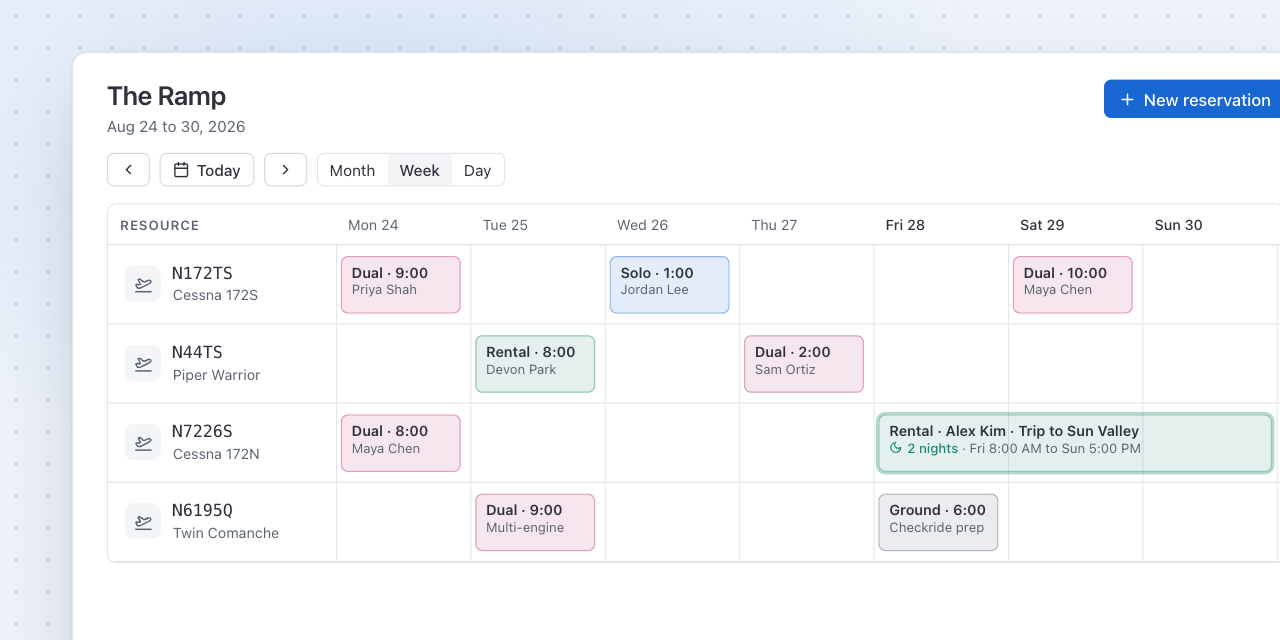
  11. Overnight and multi-day trips

    The week board with a rental trip spanning Friday to Sunday

    Renters can take the airplane somewhere. The booking form asks when the aircraft goes out and when it comes back, and the week board shows the whole trip as one block.

    A minimum for each night away

    An aircraft parked at someone else's airport is an aircraft nobody else can fly. Set a minimum number of hours per night, and a short flight over a long weekend still bills fairly.

    Turn it on

    1. Set your organization's time zone under Settings, then Organization.
    2. Open Settings, then Booking preferences.
    3. Turn on Allow multi-day bookings.

    Nights are counted in the airport's own time zone, which is why the setting waits until you have one.

    Read the guide
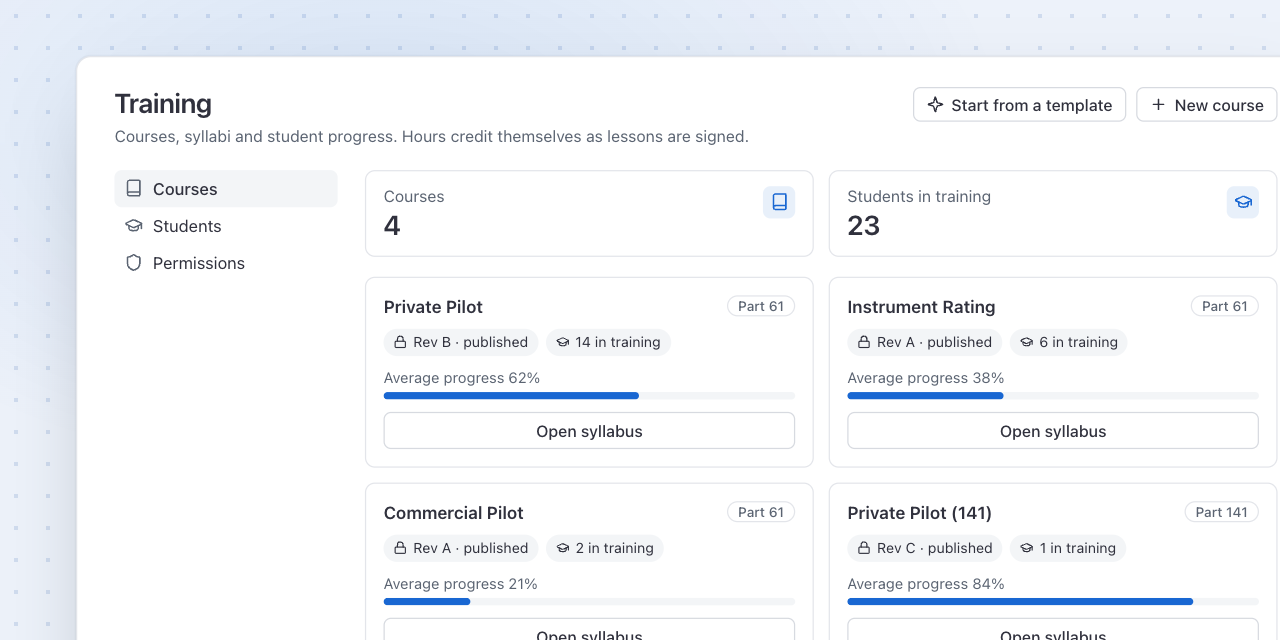
  12. Courses, syllabi and training records

    The Training page with Private Pilot and Instrument Rating courses and students in training

    Training records now live next to the schedule instead of in a binder. Build a course once, publish its syllabus, and every lesson an instructor signs credits its hours to the student's record automatically.

    Five pieces

    A course, a version of its syllabus, an enrollment, a lesson record and a requirement. You build the course, publish a syllabus version, enroll a student against it, then grade and sign each lesson from the booking. Changing the syllabus later publishes a new version, so a student partway through keeps the one they started on.

    • Your syllabus

      Stages, lessons and graded tasks, for Part 61 or Part 141, with hour and landing requirements that count themselves.

    • Graded at close-out

      Instructors grade the lesson from the booking. The instructor's signature freezes the record and credits the hours.

    • Graded offline

      On the app, grades recorded with no signal wait on the phone and are sent up when you are back in range.

    • Ready for an inspection

      Pull a student's lessons, hours and endorsements in one place when the FAA or a check airman asks.

    Students see their own progress

    Students open My training to see where they are in the course, which lessons are signed, and how many hours they still need. Nothing is hidden in an instructor's notebook any more.

    Start your first course

    1. Open Training and click Start from a template, or New course.
    2. Publish the syllabus.
    3. Enroll a student and grade their next lesson at close-out.
    Read the guide
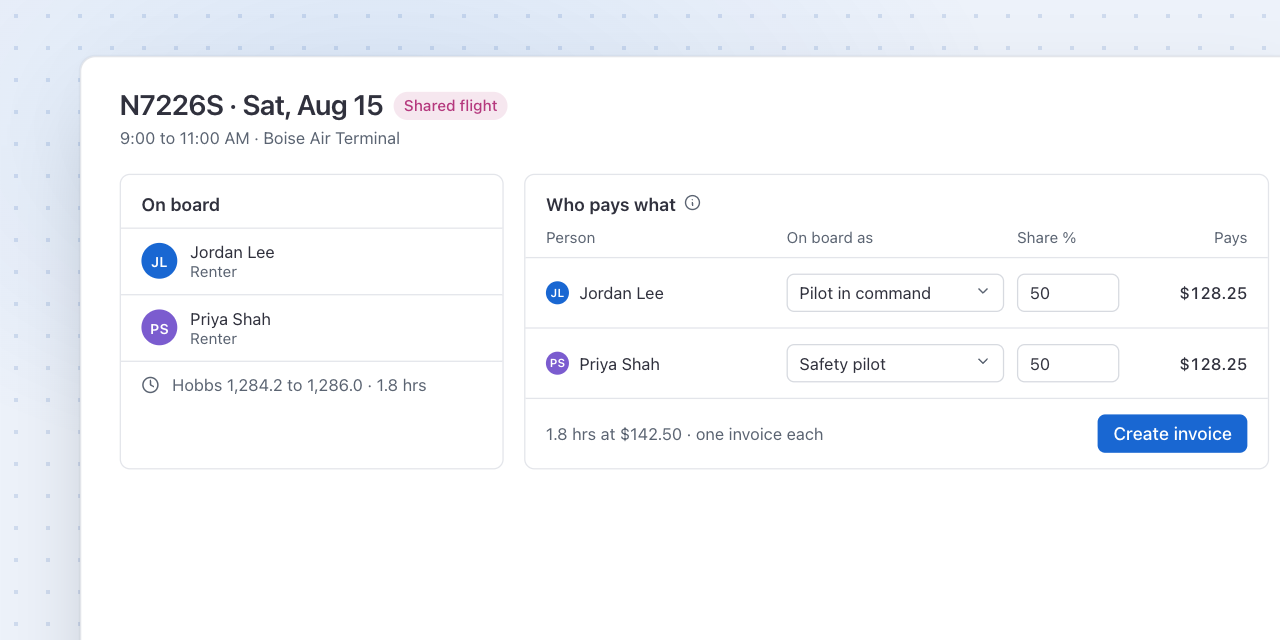
  13. Shared flights, split between the people on board

    A shared flight with two pilots and the Who pays what panel splitting the cost

    Safety pilots, time builders and flying partners can book one flight together. At close-out AerScheduler divides the cost and sends each person an invoice for their part, so nobody is chasing a friend for half the rental afterwards.

    A flight type of its own

    Shared is its own kind of booking, not a solo with an extra name on it. Put two or more pilots on the flight, and say who was pilot in command, safety pilot, second in command or passenger. That role is recorded with the flight.

    Who pays what

    On a booking with more than one payer, the Who pays what panel records each person's share: a percentage of the aircraft, or the instruction they each received. Fill it in when the aircraft is back. Each person then gets an invoice for exactly their part, paid through the same link as any other flight.

    One rule per booking type

    Owners and admins set how each kind of booking divides by default, so the desk is not working it out on a calculator every time. Each pays in full is there too, for the flights where everybody is charged the whole amount.

    Shares freeze the moment the first invoice exists, so check them before you close out.

    Read the guide
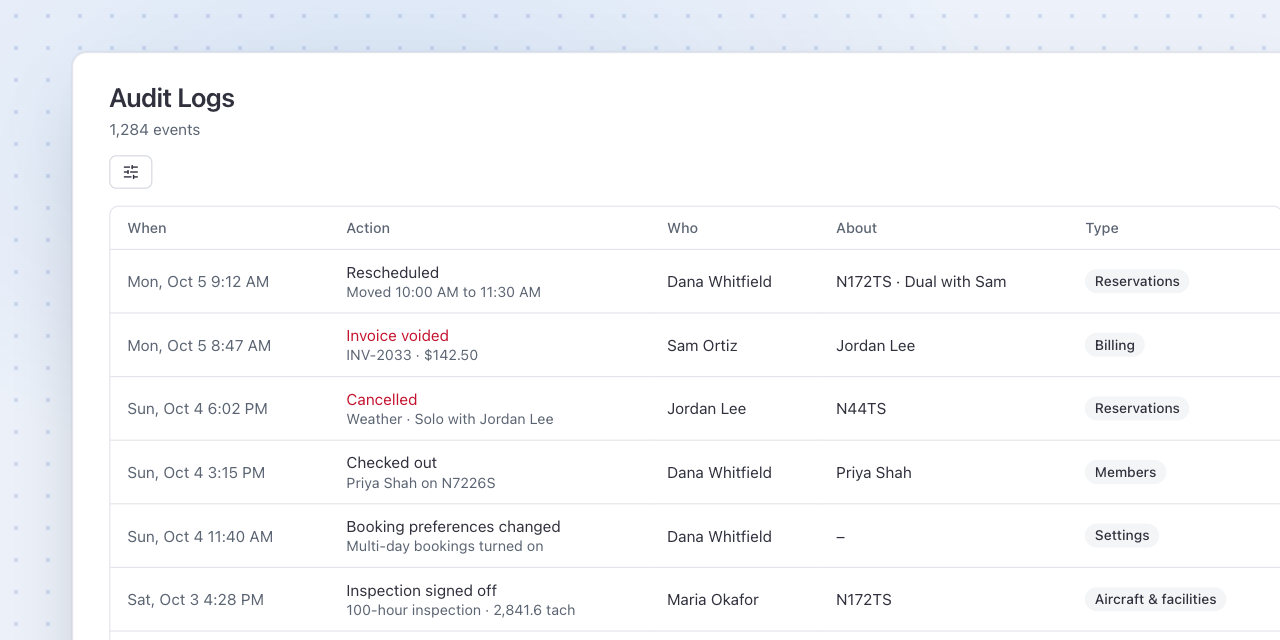
  14. See who changed what, and when

    The Audit Logs page listing changes with who made them and what they were about

    When a booking moves, an invoice is voided or an aircraft is grounded, the first question is usually who did it. Audit Logs answers it: every change across the organization, newest first, with the person, the time and the fields that changed.

    • Bookings moved, edited, cancelled and closed out
    • Invoices raised, voided and marked paid
    • Aircraft, members and settings changed
    • Whether it came from the console, the app or the API

    It cannot be edited

    Nothing in the audit log can be changed or deleted, by anyone. Only owners and admins can open it, and it covers the whole organization, so it is the record you point to when a question comes up months later.

    Read the guide
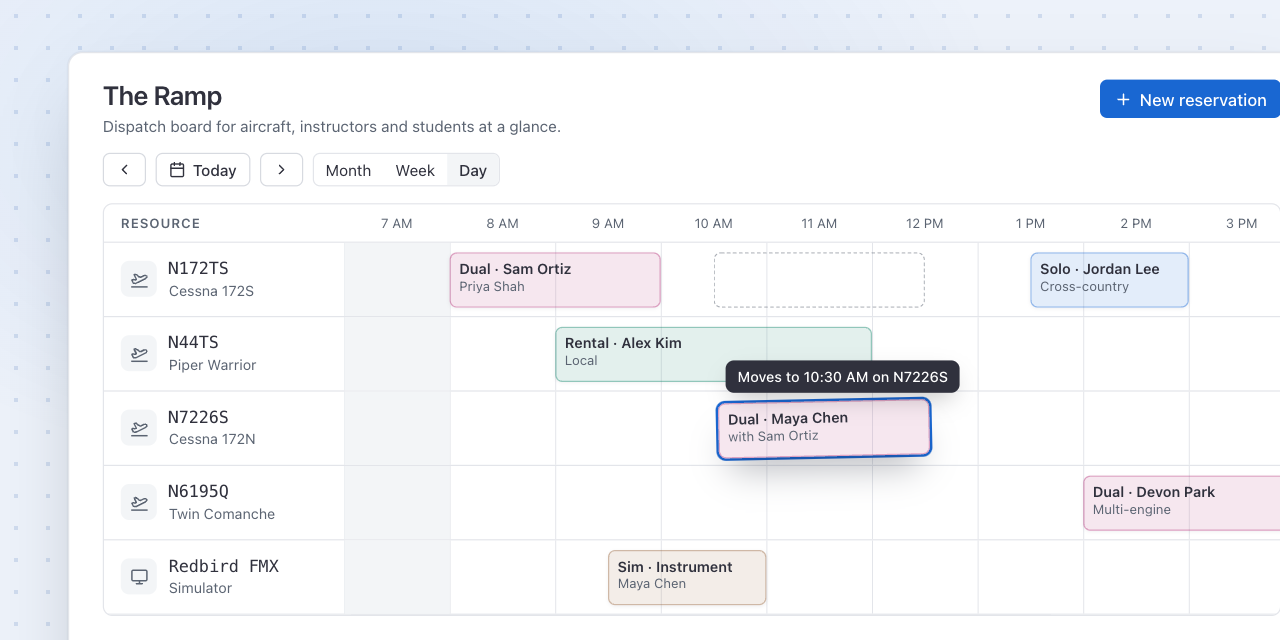
  15. Drag a booking to move it

    A dual lesson being dragged on the day board to a new time on another aircraft

    Moving a lesson used to mean opening it and retyping the times. Now the calendar works like a whiteboard.

    • Drag a block along its row to change the time
    • Drag it up or down onto another row to change the aircraft
    • Or select a block and nudge it with the arrow keys
    • If a move is not allowed, the calendar says why in a sentence
    Read the guide
  16. The AerScheduler API

    Enterprise organizations can now create API keys under Settings and connect AerScheduler to their own systems: a website that shows live availability, a payroll export, a data warehouse. Every endpoint is documented, with examples, in the API reference.

    The API is part of the Enterprise plan.

    Read the guide
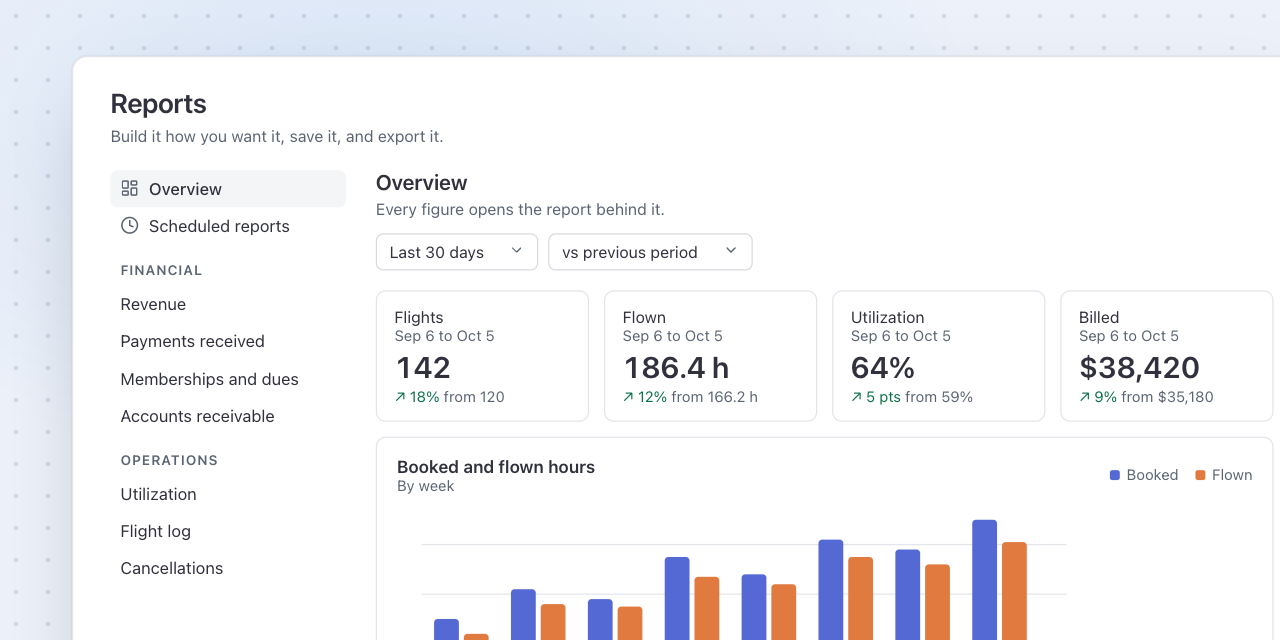
  17. Reports you can build, save and send

    The Reports page: the Overview dashboard with flights, hours flown, utilization and billing

    Reporting now lives on one page. Pick a report, set the dates, filter it, group it, and keep the version you like as a saved view that anyone in the organization can open. Every report answers on your organization's clock, so a day means your day, not the server's.

    The reports

    Money: revenue, payments received, items sold, memberships and dues, tax collected and accounts receivable. Flying: utilization, the flight log, cancellations and no-shows, and booking requests. Maintenance: squawks and downtime, maintenance due and airworthiness compliance. Each one opens with a sensible default and goes as deep as you need.

    • Group and rank

      Group any report to compare aircraft, instructors or students side by side, and see who is flying the most or which tail sits idle.

    • On a schedule

      Email a saved view as a CSV every day, week or month, at an hour on your own clock. Send it to yourself or straight to your accountant.

    • CSV or PDF

      Export any report to a spreadsheet or a PDF ready to print or file.

    An Overview that is yours

    Pin the figures you check every morning to your own dashboard: flights, hours flown, utilization, billed and collected, each compared with the period before. Every number opens the report behind it, already filtered.

    Who sees which report follows their role: financial reports stay with owners and admins, dispatchers see the rest, and technicians see fleet and maintenance.

    Read the guide
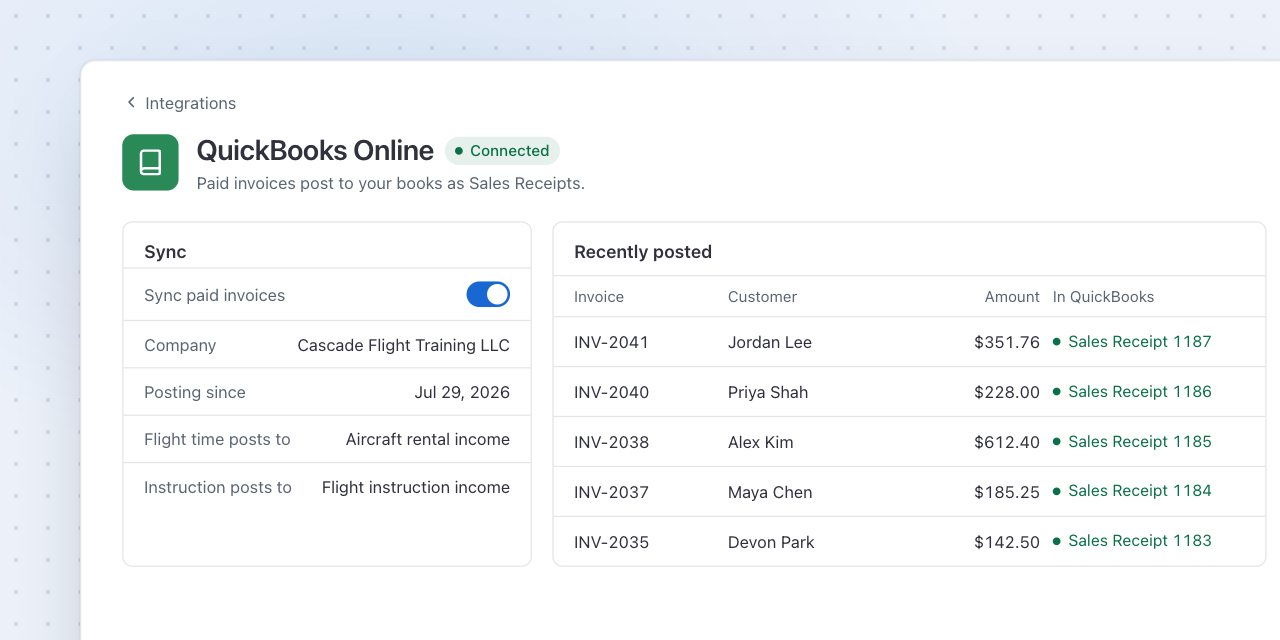
  18. Paid invoices, straight into QuickBooks

    The QuickBooks Online settings page, connected, with paid invoices posted as Sales Receipts

    No more typing flight invoices into QuickBooks at the end of the month. Once you connect, each invoice paid on or after the date you choose posts to your books as a Sales Receipt, with the customer and the accounts you picked.

    • Paid invoices become Sales Receipts
    • You choose the account each kind of charge posts to
    • You pick the start date, so older invoices stay out
    • Nothing is sent until every setup question is answered

    Your books, not ours

    AerScheduler asks before it writes anything, and it never posts the same invoice twice. Your accountant keeps working in QuickBooks the way they always have, and the setup page lists anything that could not be posted along with what to do about it.

    Connect it

    1. Open Settings, then Integrations, then QuickBooks Online.
    2. Connect your Intuit company and answer the setup questions.
    3. Turn sync on.
    Read the guide
  19. Book a lesson that repeats every week

    A student who flies every Tuesday and Thursday at 4 no longer needs eight separate bookings. Fill in the first one, open Repeat, pick how often, and AerScheduler books every date.

    • Each date is a real booking of its own, ramped out, closed out and invoiced on its own
    • If any one date clashes with another booking, none of them are made, so you never end up with half a series
    • Cancel one lesson without touching the rest
    Read the guide
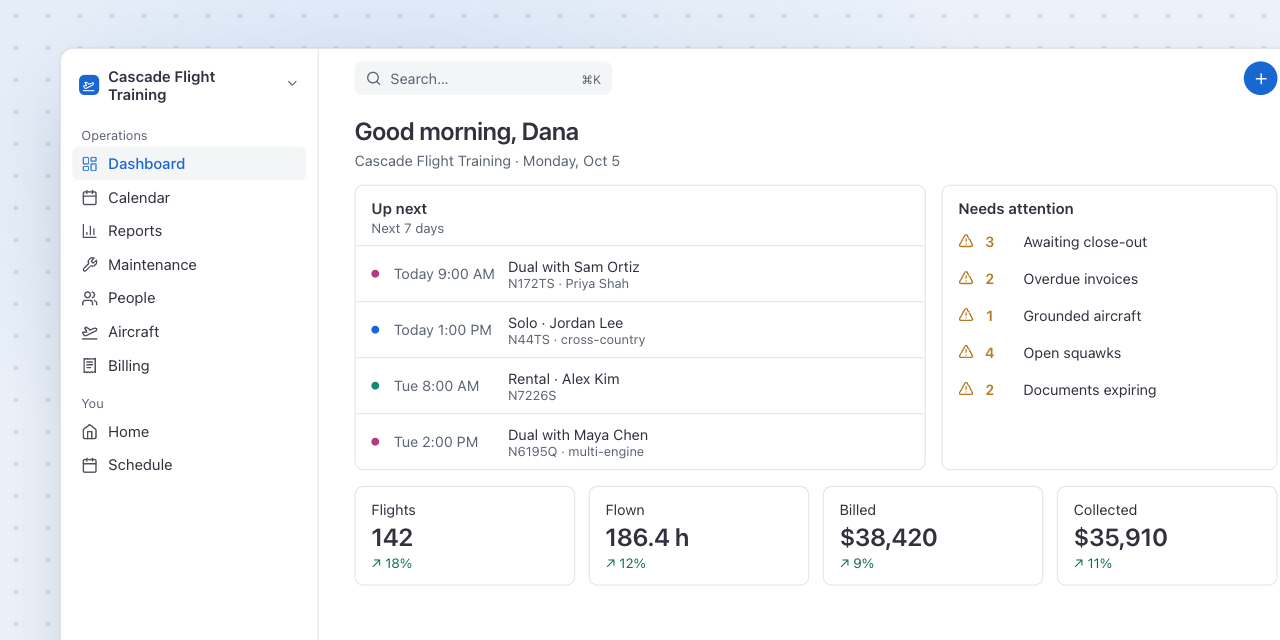
  20. A new web console, built for the desk

    The new AerScheduler console: the dashboard with what is up next and what needs attention

    The web console is the place the front desk lives all day, so we rebuilt it. Every page is new, from the dispatch board to billing, and your data, logins and settings carried over untouched.

    Everything on one screen

    The dashboard opens on what is flying next and what needs someone today: overdue invoices, flights waiting to be closed out, grounded aircraft and documents about to expire. Every number is a link to the list behind it, so the morning routine is a few clicks instead of a hunt.

    Find anything with one search

    Press Cmd K (Ctrl K on Windows) from any page to find a person, an aircraft, a booking or a setting by typing a few letters. What it finds depends on your role, so a student searching sees their own flights and an admin sees the whole organization.

    • A real dispatch board

      Aircraft, instructors and rooms down the side, the day across the top, every booking colored by type.

    • A view for every role

      Students and renters get their own schedule, invoices and documents. Staff get the whole operation.

    • Light or dark

      Pick a theme from the menu under your organization's name, or let it follow your computer.

    • Works on a phone browser

      The navigation folds into a menu and every form fits a small screen, for the times the app is not installed.

    Nothing to switch on: sign in at app.aerscheduler.com, the same address as before.

    Read the guide